
Clay Block vs. Clay Pad: Both the clay block and clay pad are tools used in automotive detailing to remove contaminants like tar, sap, and industrial fallout from the surface of a vehicle. While they serve the same purpose, they differ in design, application, and certain practical aspects.
Clay Block
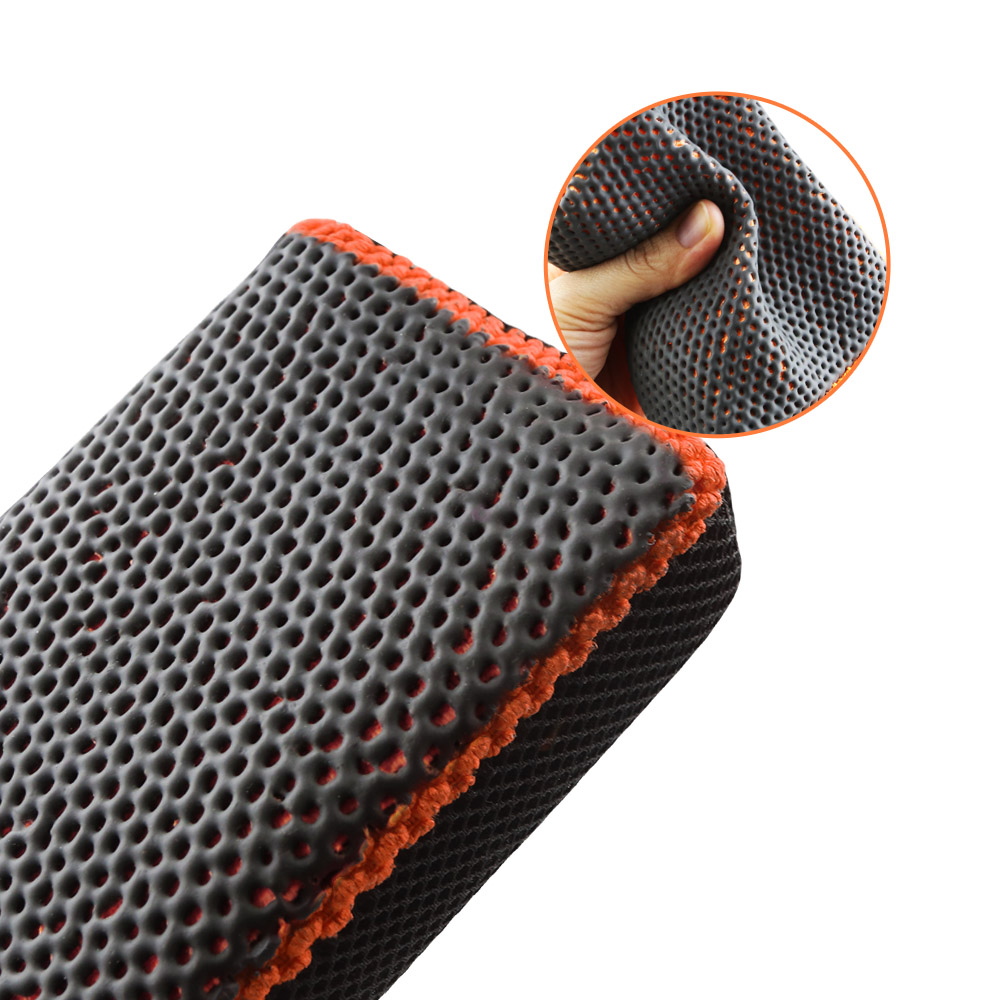
- Material: Typically made of a rubberized or polymer material attached to a foam or plastic block.
- Application: Used by holding the block in your hand and gliding it over the lubricated surface of the vehicle.
- Size: Compact, usually fitting comfortably in the hand with a larger surface area than traditional clay bars.
- Contaminant Removal: Very effective for removing embedded contaminants. Best suited for large, flat surfaces.
- Usability: Provides good control and precision. Its size makes it easy to maneuver, but it can be tiring to use over very large areas.
- Durability: Durable and reusable. If dropped, it can be easily rinsed and reused without much risk of contamination.
- Cost: Generally mid-range, more expensive than a traditional clay bar but less or similarly priced compared to clay pads.
Clay Pad
- Material: A rubberized or polymer clay material typically attached to a foam pad that can be used by hand or attached to a dual-action (DA) polisher.
- Application: Can be used by hand for detailed work, but more commonly, it's attached to a DA polisher for larger, more efficient coverage. The DA polisher helps glide the pad over the lubricated surface.
- Size: Usually larger than a clay block, with the pad covering a broader area, especially when attached to a polisher.
- Contaminant Removal: Equally effective at removing contaminants, but when used with a DA polisher, it can clean larger areas much faster.
- Usability: Very user-friendly, especially when paired with a DA polisher. It requires less physical effort than a clay block, making it ideal for large or multiple vehicles. However, it offers less control when used manually.
- Durability: Also durable and reusable. Like the clay block, it can be rinsed and reused if dropped.
- Cost: Generally more expensive than a clay block, especially when considering the cost of a DA polisher if you don’t already own one.
Which is Better?
- Ease of Use: The clay pad, especially when attached to a DA polisher, is easier and faster to use over large areas. The clay block offers better control for manual detailing but requires more effort.
- Surface Coverage: The clay pad covers more area per pass, making it more efficient for large surfaces. The block, while precise, is slower for large jobs.
- Speed: The clay pad is faster, especially when used with a DA polisher. The clay block is slower but provides more precision.
- Control: The clay block offers better manual control, making it ideal for small areas and intricate details. The clay pad is less precise but more efficient overall.
- Durability: Both are durable and reusable, provided they are maintained properly. The clay pad may wear out faster when used with a polisher due to the increased friction.
- Cost: The clay pad is generally more expensive, especially if you factor in the cost of a DA polisher. The clay block is more affordable and might be more cost-effective for smaller jobs or occasional use.
Conclusion: If you’re working on large surfaces or multiple vehicles and want to save time, especially if you have or are willing to invest in a DA polisher, the clay pad is likely the better option. It’s faster and less physically demanding. However, if you prefer more control, need to work on smaller or intricate areas, or are looking for a more budget-friendly option, the clay block would be the better choice.


