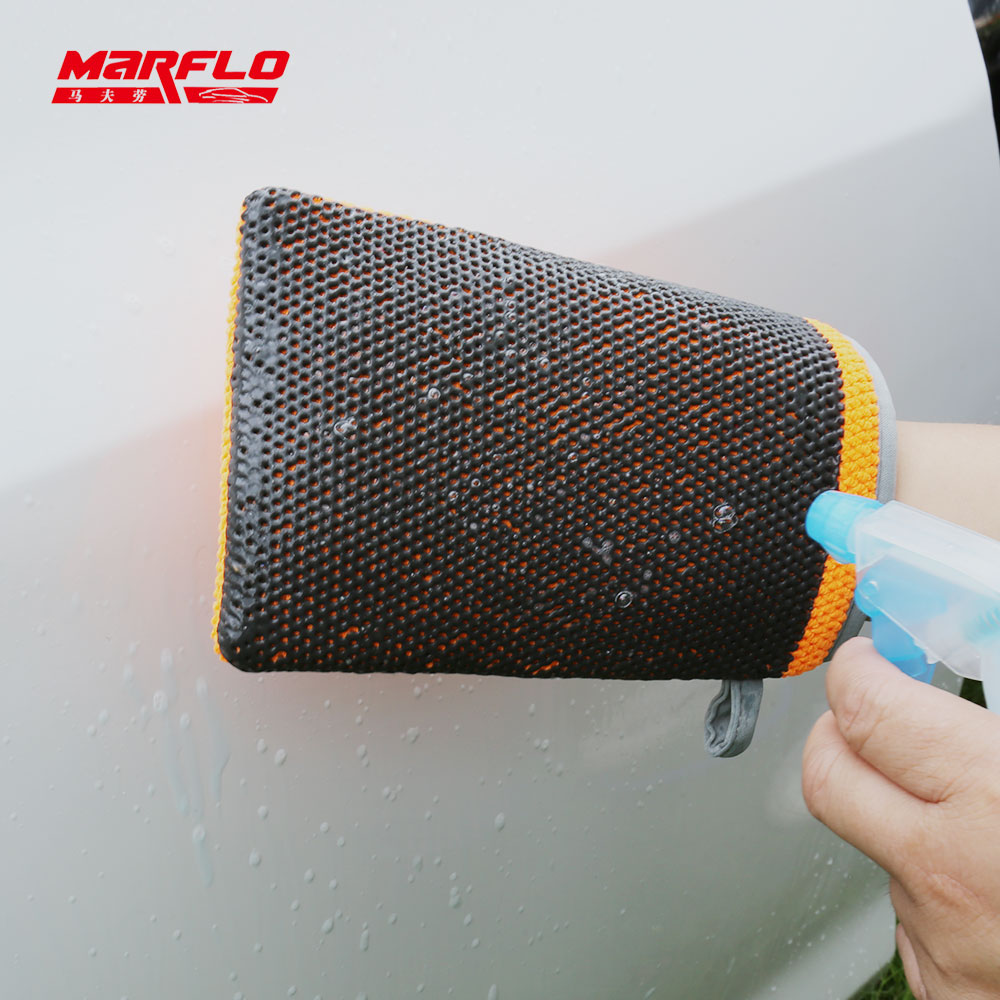
Clay Block vs. Clay Mitt: Both the clay block and clay mitt are advanced tools used in automotive detailing to remove contaminants from the paint surface. They both serve the same purpose but differ in design, usability, and other aspects.
Clay Block
- Material: Rubber polymer material attached to a foam block or pad.
- Application: Used with a clay lubricant, the block is held in your hand and glided over the surface of the vehicle.
- Size: Larger surface area than traditional clay bars, allowing for quicker work.
- Contaminant Removal: Highly effective at removing contaminants; ideal for large flat surfaces.
- Usability: Generally easier to clean and reuse compared to a clay bar. Provides more control than a mitt but can be tiring to use over large areas.
- Durability: Can be reused multiple times if cleaned properly. Less likely to cause scratches if dropped, as it can be rinsed off.
- Cost: Generally more expensive than traditional clay bars but can be cost-effective over time due to reusability.
Clay Mitt
- Material: Rubberized clay material bonded to a mitt, typically made from microfiber or a similar material.
- Application: Worn on your hand like a glove, allowing for easy movement and coverage with the entire hand.
- Size: Covers a large area and conforms to the shape of the surface being worked on, making it easy to use on curved surfaces.
- Contaminant Removal: Equally effective at removing embedded contaminants. The flexibility of the mitt allows for better access to contours and hard-to-reach areas.
- Usability: Very user-friendly, especially for beginners. The mitt offers a secure grip, making it easier to use for longer periods without hand fatigue. Can be cleaned and reused multiple times.
- Durability: Durable and reusable. Like the clay block, it should be cleaned thoroughly to prevent scratching. If dropped, it can also be rinsed off and reused.
- Cost: Slightly more expensive than a clay block or bar but offers excellent value due to ease of use and durability.
Which is Better?
- Ease of Use: The clay mitt is generally easier to use, especially for beginners, as it fits on your hand like a glove and provides a comfortable, natural motion. The clay block offers more control, but it can be tiring over large areas.
- Surface Coverage: The mitt provides better flexibility for curved surfaces and tight areas. The block is better for flat, large surfaces but may be less convenient for intricate details.
- Speed: Both tools are faster than traditional clay bars, but the mitt might edge out the block in terms of speed due to its natural grip and movement.
- Durability: Both are durable and reusable, but the mitt’s design might make it easier to handle for longer detailing sessions.
- Cost: Both are similar in cost, with the mitt possibly being slightly more expensive. However, both are cost-effective in the long run due to their reusability.
Conclusion: If you prioritize comfort, ease of use, and flexibility, the clay mitt might be the better choice. It’s especially good for beginners or for working on vehicles with many curves and intricate details. The clay block, on the other hand, offers more control and is better suited for large, flat surfaces, making it ideal for those who prefer a more traditional tool but with modern advantages.


