
A clay block is a synthetic clay tool that removes bonded contaminants (fallout, brake dust residue, rail dust, overspray, and mineral deposits) while staying easy to hold and fast to use. Unlike a traditional clay bar, a clay block’s sponge or microfiber backing holds water during washing, which continuously lubricates the surface and helps it glide safely. This makes clay blocks popular for DIY users and express wash/detail shops because they speed up decontamination without complicated technique.
When to choose a clay block:
Choose a clay block when you want fast, controlled decontamination on large panels (hood, roof, doors), especially during a wash process where water lubrication is naturally available.
Key differences vs clay bar:
Clay block: faster coverage, better grip, less drop-risk, easier for beginners, ideal for wash-stage decon
Clay bar: higher precision for tight areas and spot work, flexible shape control, best for detail-focused users
Best lubrication rule:
Use plenty of water or a pH-neutral lubricant (about 6.5–7.5). Avoid strong acidic/alkaline cleaners that may leave residue or create unwanted reactions.
Clay blocks are one of the most misunderstood tools in modern car detailing.
Some people think they are just a “new shape” of clay.
Others assume they are only for beginners.
Some believe they are less effective than traditional clay bars.
In reality, clay blocks exist for a very specific reason—and when used correctly, they solve problems that neither clay bars nor chemical cleaners can solve as efficiently.
This guide explains what a clay block really is, how it works, why it stays safe, and why it has become popular among DIY users and fast-paced car wash operations alike.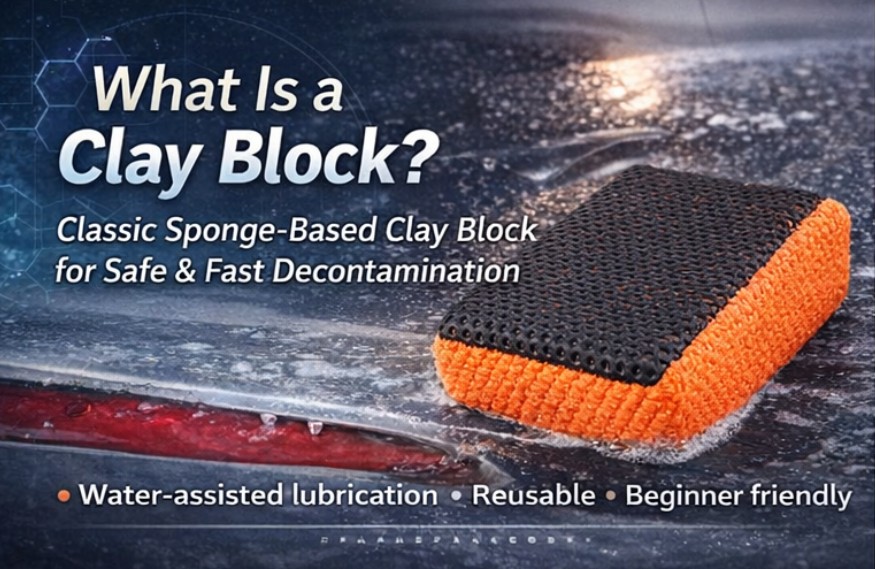
A clay block is a surface decontamination tool that combines:
a clay polymer working layer, and
a water-holding support structure (most commonly a sponge or a microfiber-wrapped sponge).
Its purpose is the same as a clay bar:
to remove bonded contaminants that remain on paint after washing.
The difference is how lubrication is delivered during use.
Traditional clay bars work well—but they rely heavily on external lubrication.
That means:
constant spraying,
higher risk of dry spots,
More attention is required from the user.
Clay blocks were developed to reduce these risks by building lubrication into the tool itself.
This design shift made clay safer and more predictable for:
DIY users,
quick-service car washes,
These environments are characterized by high-frequency use.
The most important feature of a clay block is water retention.
During washing:
the sponge or microfiber backing absorbs water.
water continuously feeds the clay surface.
Lubrication is maintained naturally.
This means:
less friction,
smoother movement,
This results in a decreased probability of user error.
In simple terms:
The block stays wet as long as the wash process continues.
Like a clay bar, a clay block:
does not cut paint,
does not grind the surface,
does not rely on chemicals.
It works by controlled adhesion—gently gripping contaminants that protrude above the clear coat and lifting them away.
Think of it like this:
a soft eraser removing pencil marks without damaging the paper.
A properly used clay block:
does not abrade,
does not thin clear coat,
does not dissolve surface material.
Safety depends only on one condition:
adequate lubrication.
Because clay blocks naturally hold water, they often provide more consistent lubrication than manual spraying.
Water works well because:
it is pH neutral.
it leaves no residue.
it does not interfere with wax or coatings.
it does not alter the clay structure.
This makes clay blocks especially suitable for users who want:
simplicity,
predictability,
minimal chemical interaction.
Clay blocks did not appear overnight in their current form.
They evolved through real-world use and feedback.
The earliest clay blocks used pure sponge backing.
Why this design remains popular:
excellent water retention,
soft and forgiving feel,
strong adaptability to curves and irregular shapes,
low fatigue during extended use.
Despite newer designs, classic sponge blocks remain best sellers—especially for:
daily washing,
curved panels,
users prioritize safety over speed.
To improve control and durability, manufacturers introduced:
microfiber fabric wrapped around the sponge core.
This upgrade provided:
better grip,
improved surface feedback,
enhanced water distribution,
cleaner appearance.
These designs perform especially well on:
large panels,
lightly contoured surfaces,
users who prefer a more “towel-like” feel.
Some clay blocks use EVA foam for structural rigidity.
While EVA looks clean and modern, it has limitations:
reduced water retention,
higher stiffness,
poorer adaptability on complex curves,
less forgiving on edges and tight areas.
In practice, sponge-based and microfiber-wrapped designs consistently outperform EVA-based blocks in real-world washing, especially on:
bumpers,
mirrors,
Trim adjacent panels.
This is why softer, water-holding structures continue to dominate the market.
DIY users value:
safety,
ease of use,
There is a minimal chance of errors occurring.
Clay blocks deliver:
fewer steps,
less spraying,
more consistent results.
The user feels:
smoother motion,
less resistance,
immediate surface improvement.
This confidence matters more than speed.
Fast-service operations face different challenges:
time pressure,
staff turnover,
inconsistent skill levels.
Clay blocks help because they:
simplify training,
reduce dependence on technique,
lower the chance of dry claying,
work naturally during washing.
For many shops, clay blocks become a process upgrade, not just a product choice.
Clay blocks are not one-size-fits-all.
Different models exist to support:
hand size differences,
surface area coverage,
workflow preferences.
Common variations include:
compact blocks for detail work,
wider blocks for large panels,
sponge-only designs,
microfiber-wrapped designs.
Some designs incorporate proprietary structural improvements protected by patents—ensuring durability, water control, and long-term stability.
(Details vary by model and application.)
Clay blocks:
excel during washing,
favor speed and safety,
Reduce reliance on external lubrication.
Clay bars:
offer maximum precision,
excel in tight areas,
allow controlled spot correction.
They are not competitors—they are complements.
“Clay blocks are only for beginners.” → False
“Clay blocks are less effective.” → False
“Clay blocks damage paint.” → False
Misuse causes problems—not the tool.
A clay block is ideal when:
washing and decontaminating in one step,
working on curved or irregular panels,
prioritizing safety and consistency,
training new users or staff.
Clay blocks exist because detailing evolved.
They reduce risk, simplify processes, and deliver predictable results.
For DIY users, they build confidence.
For quick-service shops, they improve efficiency.
For professionals, they complement precision tools.
Clay blocks are not a replacement —
They are a practical evolution.


